
What Is Supported Community Living—and Why It Matters for Our Community
What is Supported Community Living?
Supported Community Living (SCL) is a one-on-one service for people who have Medicaid and who qualify for Supported Community Living waiver service. It is primarily supported by the Intellectual Disability (ID) and the Brain Injury (BI) Waiver.
In SCL, participants work on specific goals created with their families, case managers, and team members from Hand in Hand. These goals can include things like learning how to communicate with peers and improving social skills to things like being safe out in the community or learning how to complete tasks independently.
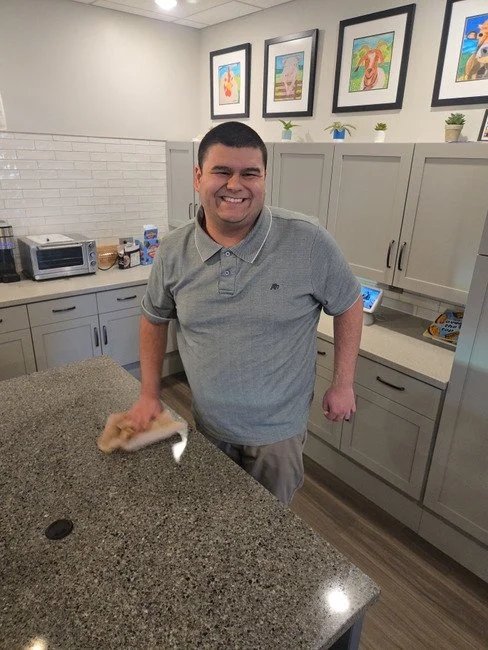
Participants may also practice things like transitioning from one task to another, such as cleaning up to get ready for lunch. Others work on social emotional regulation to practice things like breathing techniques, practicing kind words, or taking a walk when they are upset. Hand in Hand provides this support in the community so children can learn real-life skills.
Disability History
Before the 1980s, many people with disabilities were in institutions. According to a report from the Administration for Community Living, “Between 1880 and 1967, the number of people living in state ID/DD institutions increased from 2,429 to 194,650.” By 1967, half of those were children.
Conditions were often very poor in these institutions. There was often overcrowding, abuse, and poor conditions, overall.
The Developmental Disabilities Act passed in 1963 to improve the lives of people with intellectual and developmental disabilities. Changing rules in Medicaid and Supplemental Security income, as well as a shifting attitude in how to treat people with disabilities, caused the number of people living in an institution to decrease dramatically. By 2020, only about 15,000 people were still housed in state-run institutions.
Supported Community Living started in the late 1960s into early 1970s in response to deinstitutionalization. More people with disabilities were living with family members or choosing a community home.
Why It’s Important
Supported Community Living’s purpose is to increase independent living skills of the participant receiving the service. It helps children build skills they need for life. Unlike an institution where people with disabilities are isolated, supported community living helps people with disabilities be independent and part of the community. They receive a choice in the activities they take part in, who they live with, and what activities they do.

SCL helps children learn real-life skills early. They can learn communication, decision making, and social-emotional skills in a real-world setting. SCL is so important for inclusion. Kids and adults can be a part of their community, their school, and after school activities and use the skills they learn during SCL.
The Barriers
Hand in Hand provides Supported Community Living in alignment with Medicaid regulations, which shape how and where SCL services are delivered. To ensure children can access this service, last year we purchased a minivan and intentionally plan staffing so individuals can receive support in the broader community. This allows children, adults, and families to work on individualized goals within their service plan.
Many families have ask about receiving SCL within our childcare program. This makes sense. Our program is inclusive, community-based, and brings together children of all abilities in a shared environment where children feel safe. It is a setting where natural peer interaction happens, and where many children are already working on communication, social, and emotional skills in real time.
Currently, we are not able to provide SCL within our childcare setting. Because of this, we have built a service model that supports children in accessing the community while still receiving the individualized support they need.
We continue to advocate with legislators and policy leaders to identify ways children with disabilities who need significant support can access typical childhood environments while also receiving the staffing support necessary to meet their goals. In the meantime, we work closely with families to navigate the current system and meet each child’s needs.
This also means we rely heavily on philanthropy to provide the staffing necessary to support various needs when other options to bill for that level of care aren’t available.